
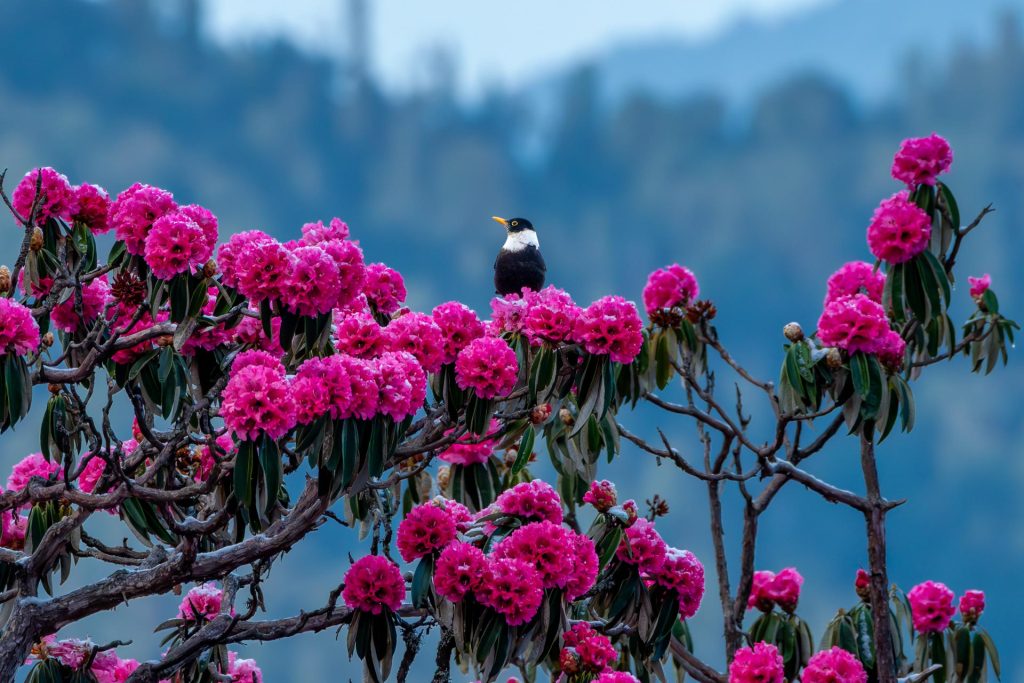
Sometimes it is not the bird but the frame that takes your breath away.
Bird photography often draws people into the pursuit of sharp close ups and frame filling the subject.
In this pursuit it is easy to forget that a photograph is more than a clean portrait. A bird is not only a subject but also a part of its world.
The habitat, the colors, the season, and the mood are all characters in the same story. When the frame captures them together, the result feels more alive.
This realization grew stronger during our hike to Tungnath Mahadev Peak at 12,000 feet in the Himalayan Mountains of Uttarakhand. As we climbed up the mountain we were greeted by an abundance of pink on all sides.
It was late winter. Rhododendron season had arrived and the trees were in full bloom. Their flowers were saturated with deeper color, and the recent snowfall had left delicate patches of white resting on the petals.
As the morning light touched them, they sparkled like tiny crystals scattered over velvet. The sight had a surreal beauty that only the Himalayas can offer.
Our purpose that morning was clear. We wanted to photograph the Himalayan Monal and the Snow Partridge, two bird species that prefer to stay at high altitude. Our minds were fixed on reaching their favoured zones as early as possible.
Little did we know that the mountains had planned a different visual treat for us long before we reached those heights.
Not far into our ascent, a quick movement caught our attention. It was a White-collared Blackbird.
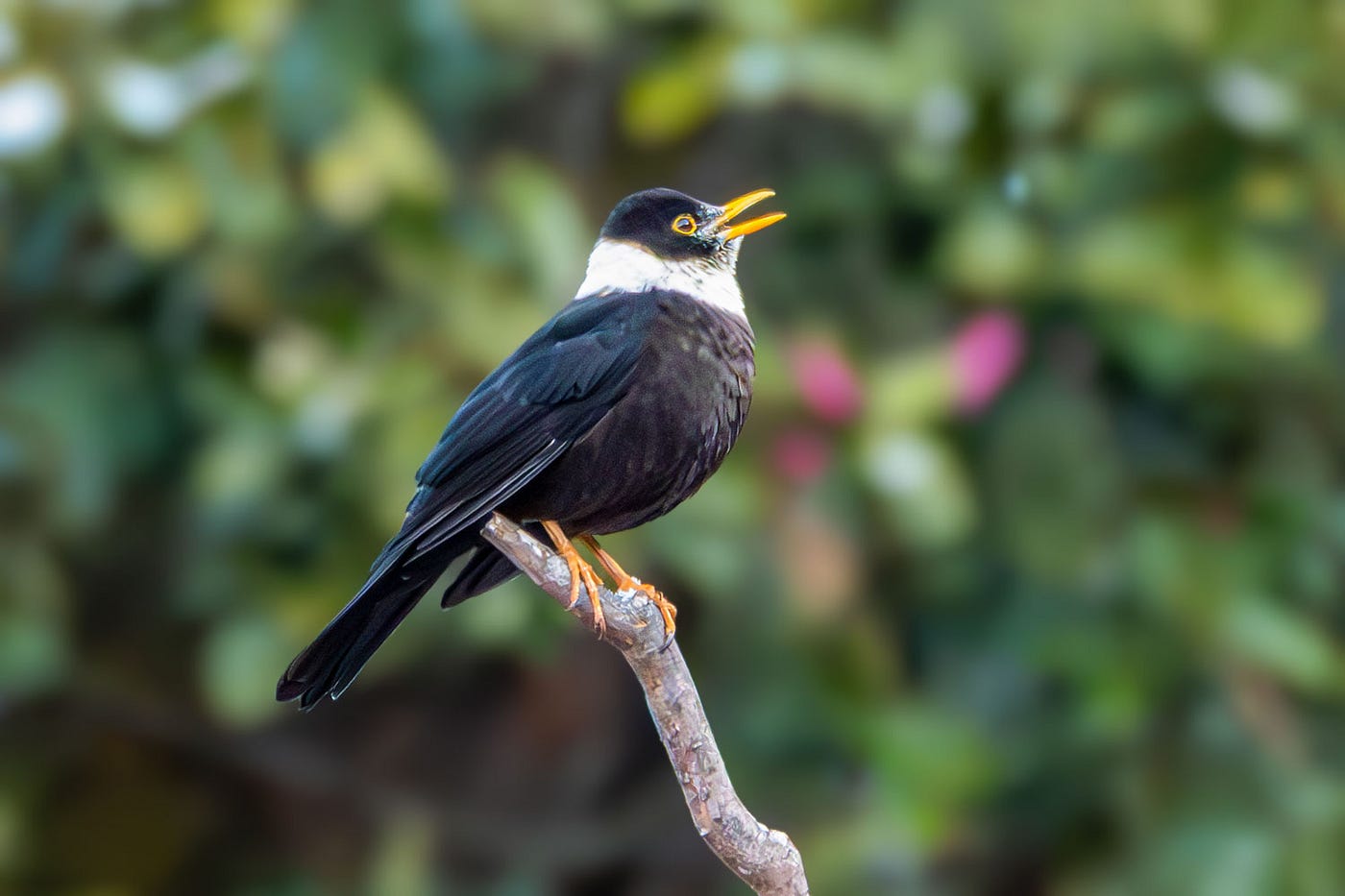
I had never seen a White-collared Blackbird before, so I observed it closely. It was restless and kept shifting from one branch to another. I managed a few close up shots when it briefly perched on bare limbs.
The bird had a striking presence with its dark plumage, white collar, and bright orange-yellow bill & eyelids, but the frame felt ordinary. They were technically fine, yet lacked a sense of place.
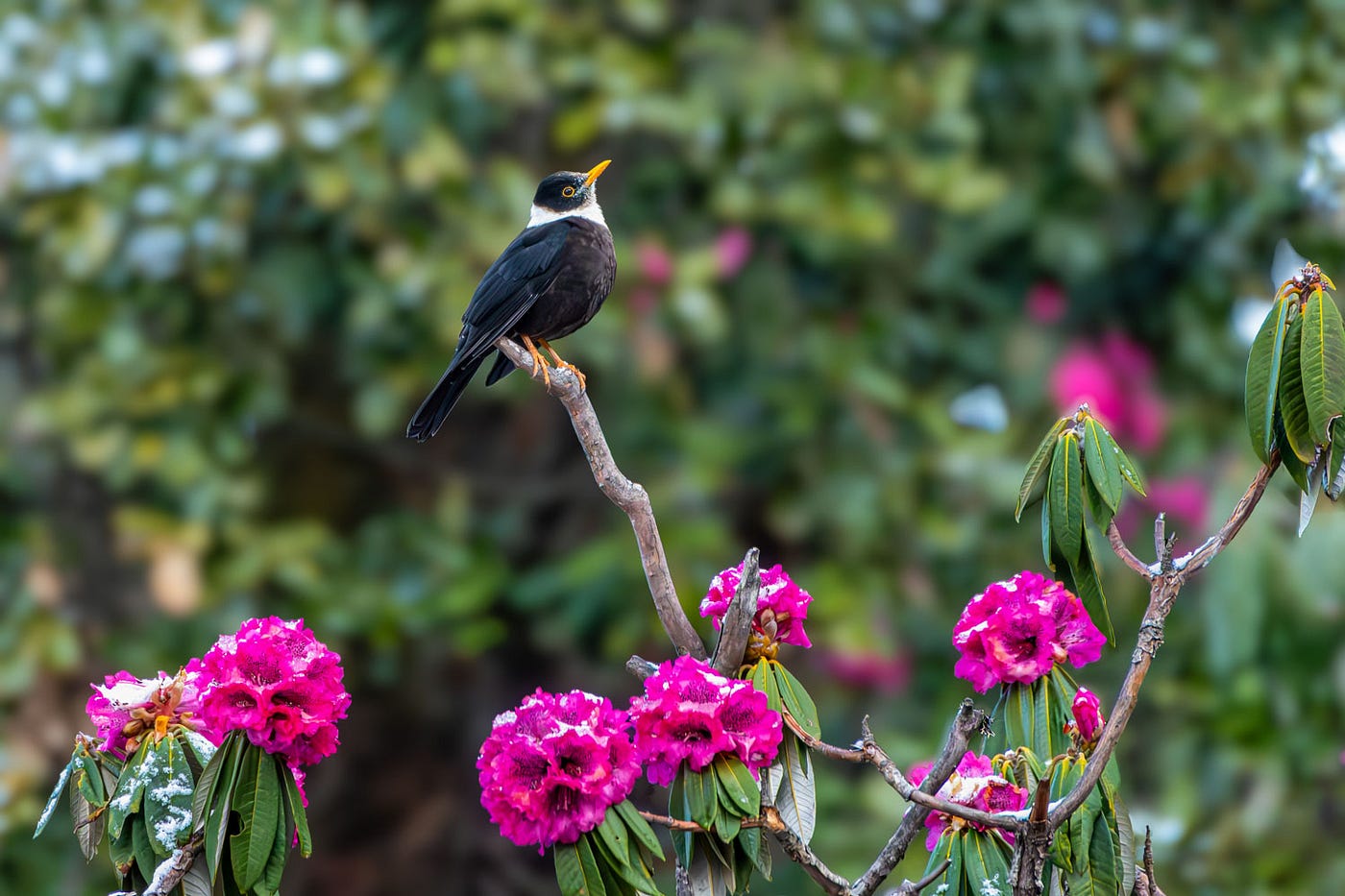
Then, without warning, the bird left the skeletal branches and flew toward a blooming Rhododendron. What happened next felt like nature arranging a composition on my behalf.
The blackbird perched gracefully on the highest tip of the rhododendron tree, which was in full bloom. The flowers were glowing with shades of pink and magenta, and the snow-dusted petals added a touch of sparkle.
The background was a soft blur of the Himalayan skyline, a cool mix of blue and distant forest. The contrast between the bird and the vibrant blossoms created a frame that felt almost unreal, as if it was a painting.
In that moment, I was reminded that the essence of bird photography lies not only in documenting the species but also in revealing the world it belongs to.
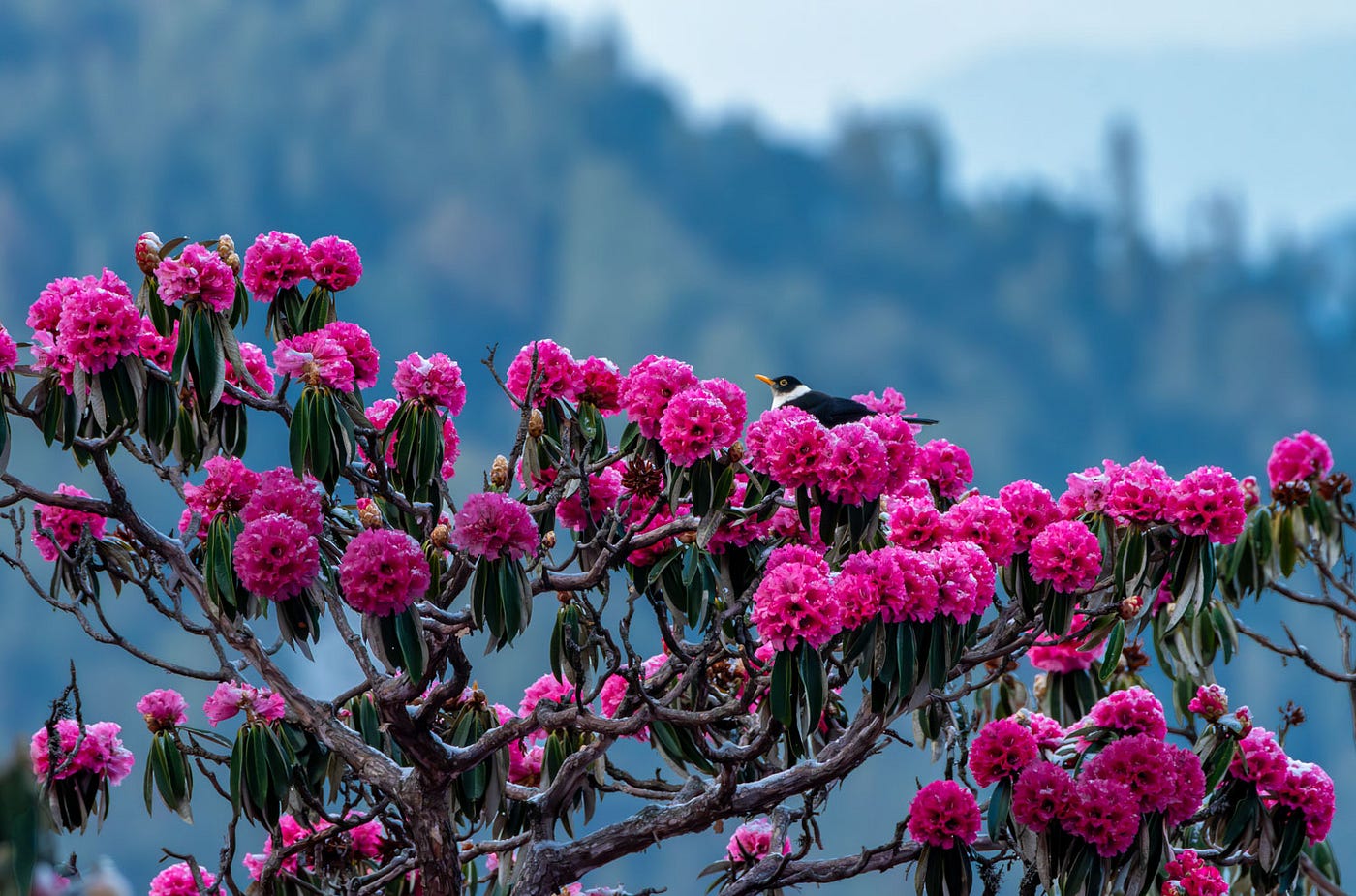
The rhododendron tree was as significant as the bird. The light was as important as the subject. The cold air, the altitude, the colors, and the silence all shaped that single moment.
Even with the best equipment, such shots are not guaranteed. You can carry the finest telephoto lens and the most advanced camera, yet frames like this depend on awareness and presence.
You must look around and not just at the bird. Wait for harmony to form between the subject and the environment.
I realised again that bird photography is not about filling every pixel with birds. It is about letting the environment breathe.
A good image shows the bird, but a great image shows the world the bird lives in.
In Tungnath that morning, the Himalayas gifted me with a frame that felt complete even before the camera shutter was clicked.