
In the cold desert of Ladakh, where the landscape changes every few kilometres, and the altitude fluctuates like a silent wave, one sound kept me company throughout my 1,500 km road trip.
The loud squawk of the Eurasian Magpie.
This bird is everywhere in Ladakh. You will find it in barren snow-covered mountains, in human settlements, on bridges, near monasteries, and even on sand dunes where you would expect nothing but wind.
As an avid birder, I always notice patterns.
What surprised me on this trip was how consistent this pattern was. No matter where I went, the same call repeatedly echoed across the vast emptiness. Sometimes it was the loud squawk or the harsh rattle, a sequence of 8–10 short notes delivered in quick bursts of 1–2 seconds.
I kept wondering how many calls this species was capable of producing. Local people told me that the magpie is known as a mimicry bird and can imitate other birds and even dog barking. That added to my curiosity.
Very few birds can survive in Ladakh, where temperatures drop below zero and the terrain shifts from rocky ridges to frozen rivers and sandy valleys. Some birds adapt to cold habitats, some to arid landscapes, and some to water bodies, but few can manage all three.
The Eurasian Magpie seems to handle all of them at once. It is one of those birds that manages to thrive in altitudes above 18,000 feet and still comfortably lives near busy human settlements in the valleys.
During my 11-day road trip, I occasionally saw them in groups or pairs and often solo. Unlike crows, which also belong to the same Corvidae family, the magpies did not harass other birds. At least I did not witness such behaviour. They seemed content in their own world.
My first sighting came on the Srinagar-Leh highway between Kargil and Leh. The mountains there are almost lunar in appearance. Barren slopes in shades of ochre, bronze, and brown. From a distance, I thought the bird was a treepie.
Gray Treepie is very common in the Himalayas, so my mind jumped straight into that assumption. But the loud squawk did not match that of a treepie. When a second bird flew in and was perched on a jagged rock, the appearance finally helped me identify it as a magpie.
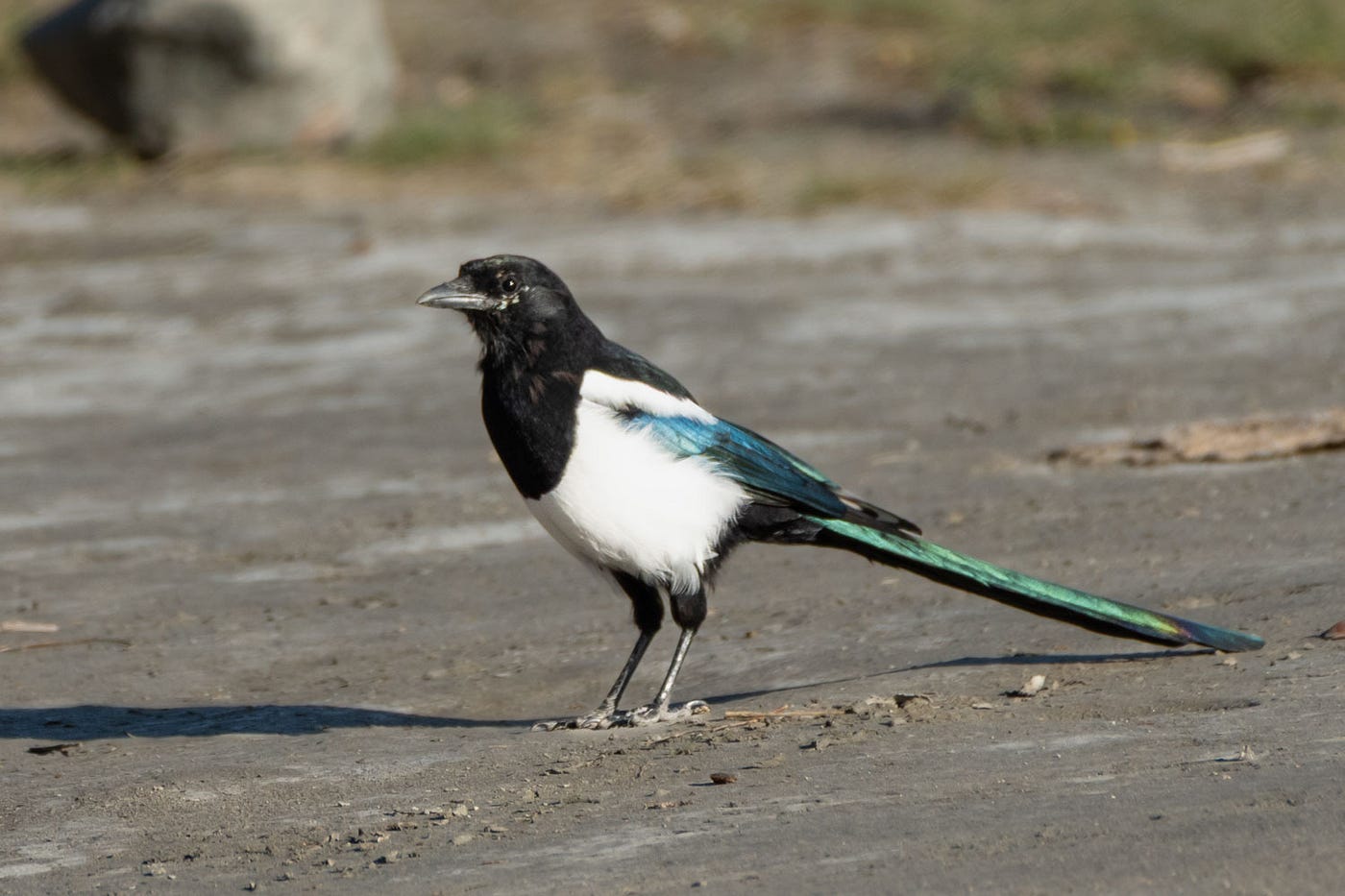
That was the moment I ditched my camera for landscape shots and took out my wildlife camera. I started clicking my first set of images of this striking bird with metallic blue and green plumage. The tail shimmered as the light hit it, almost like iridescent peacock feathers. I did not know then that I would be capturing photographs of the Eurasian Magpie over the next few days.
We reached Leh in the evening, but curiosity stayed with me. The next morning, I went up to a hilltop monastery for a sunrise shot. The sky slowly lit up in gentle shades of yellow and orange. As the light spread, the harsh rattle of the magpies echoed from below.
To my surprise, they were nesting inside the mountain’s natural cavities right beneath where I stood. As the sun rose, they emerged one by one, busy in their morning routine. They were completely unbothered by my presence. I understood then that they were used to people because this monastery becomes quite busy as the day progresses.
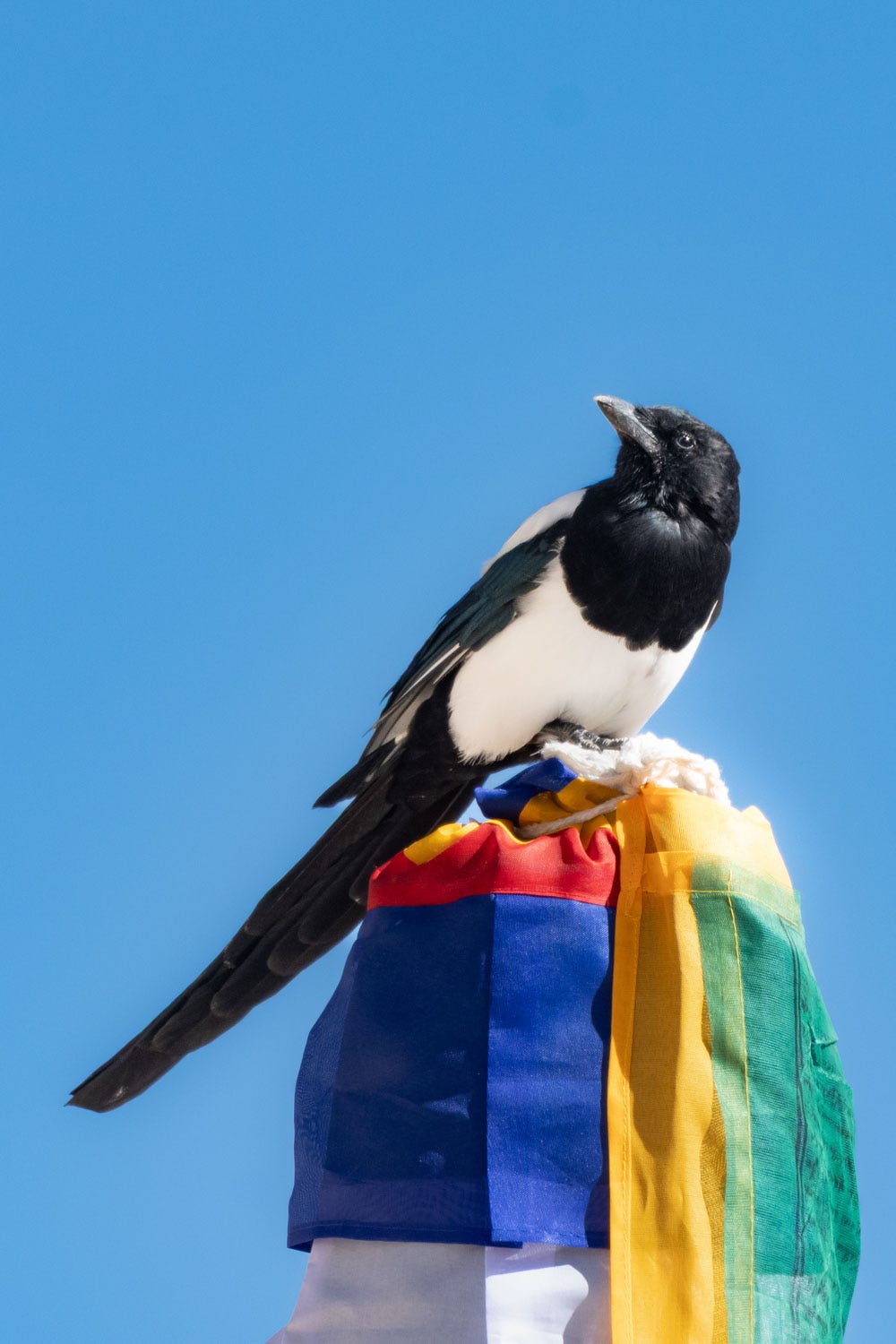
At that moment, I felt amused. The previous day on the highway, I wondered whether I would ever get to see them again. And now they appeared in large numbers at dawn as if they were telling me that we ain’t going anywhere.
The next major sighting came in Nubra Valley. This region is famous for its sand dunes and double-humped camels. It is a unique part of Ladakh, and wildlife sightings can be unpredictable. Yet, the magpies were there too. They were foraging on the sides of the sand dunes. I decided that I would photograph them against every kind of landscape I encountered on this trip.
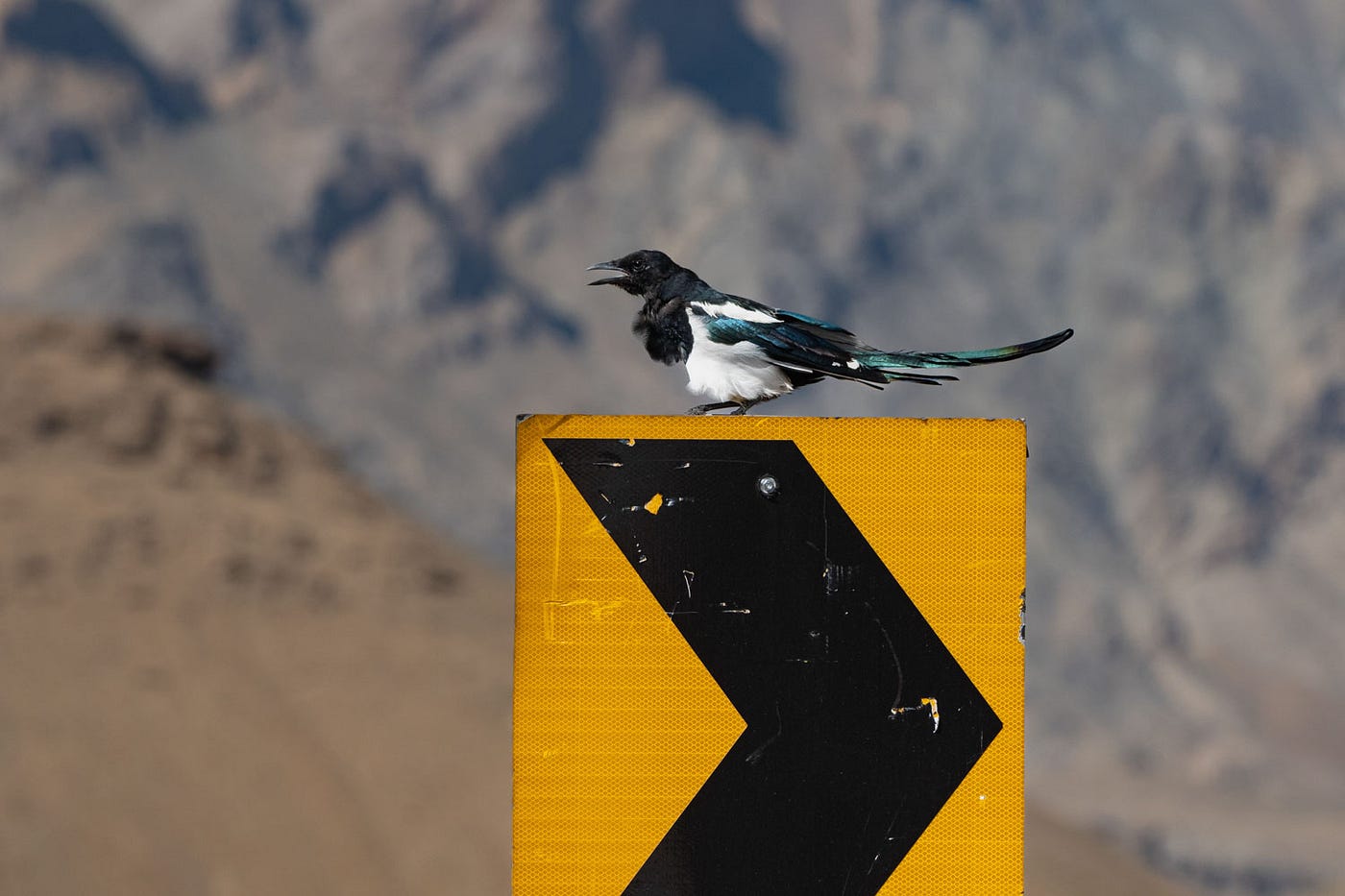
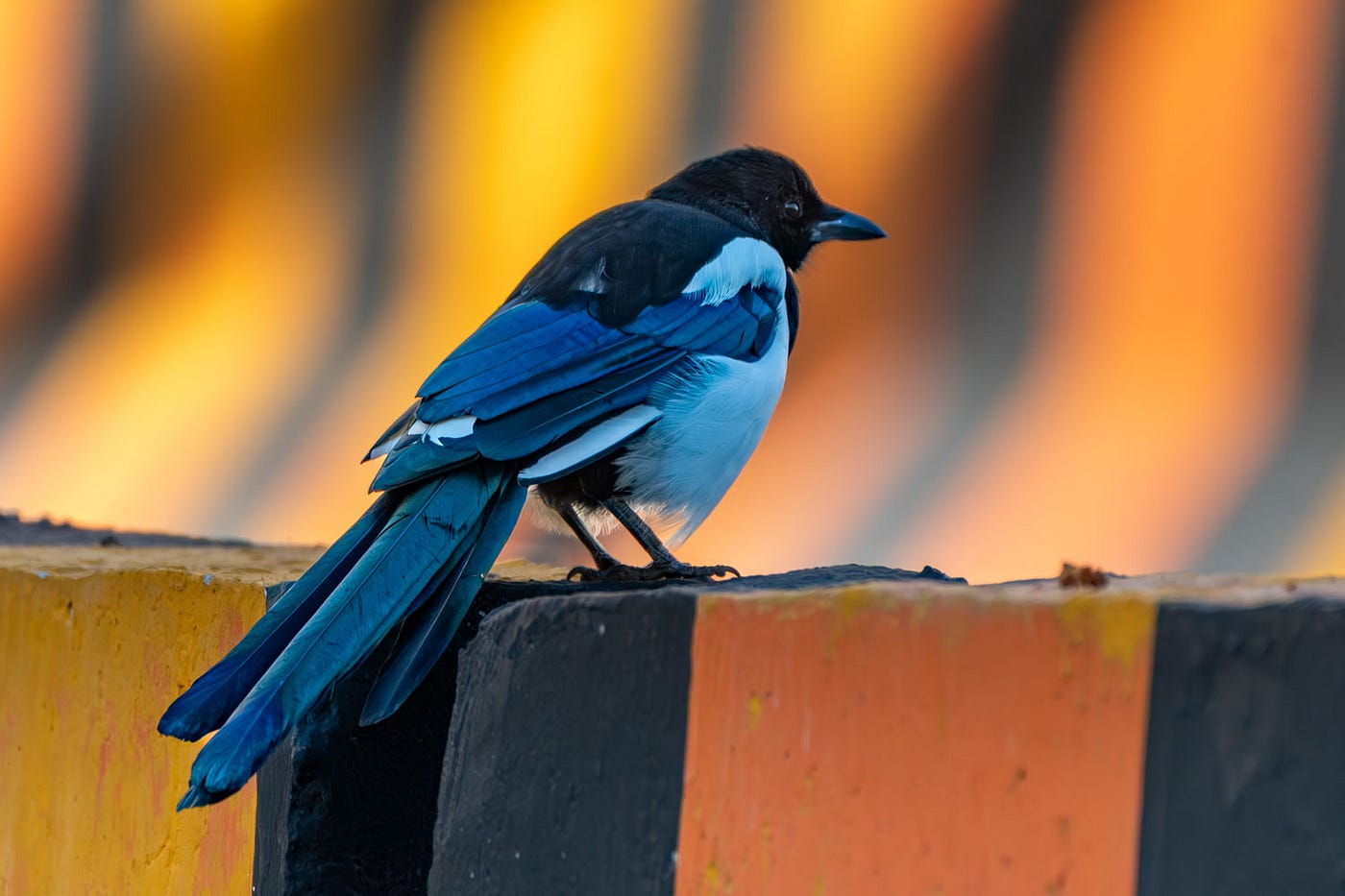
Later during the trip, we traveled past a river early in the morning. The temperature was around 5°C. We stopped for tea, and just as the sunlight touched the bridge, a magpie perched on the edge of a bridge wall. The golden light created a beautiful warm backdrop behind the bird. That became one of my favourite frames because the colours were so vivid and contrasting in a cold desert.
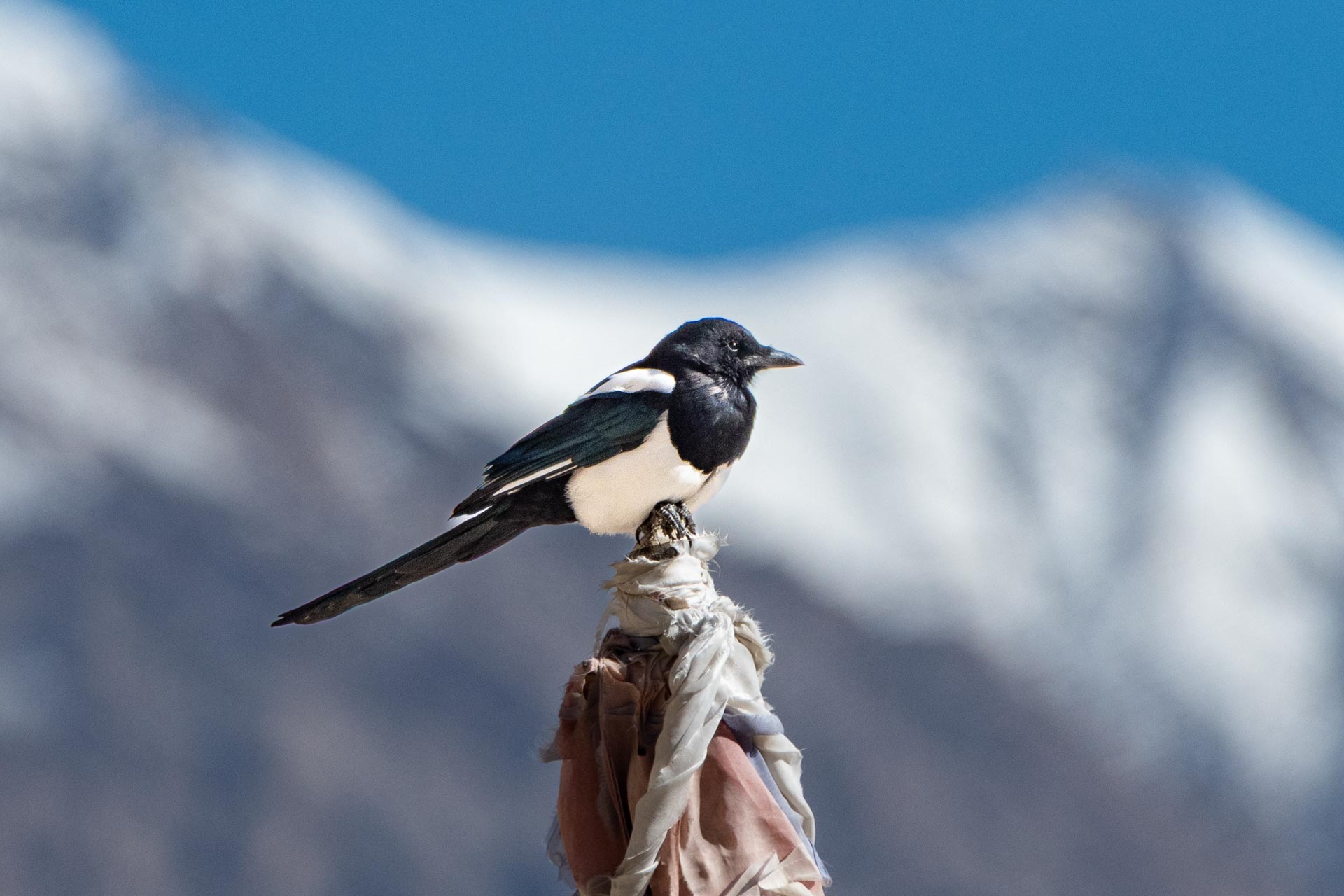
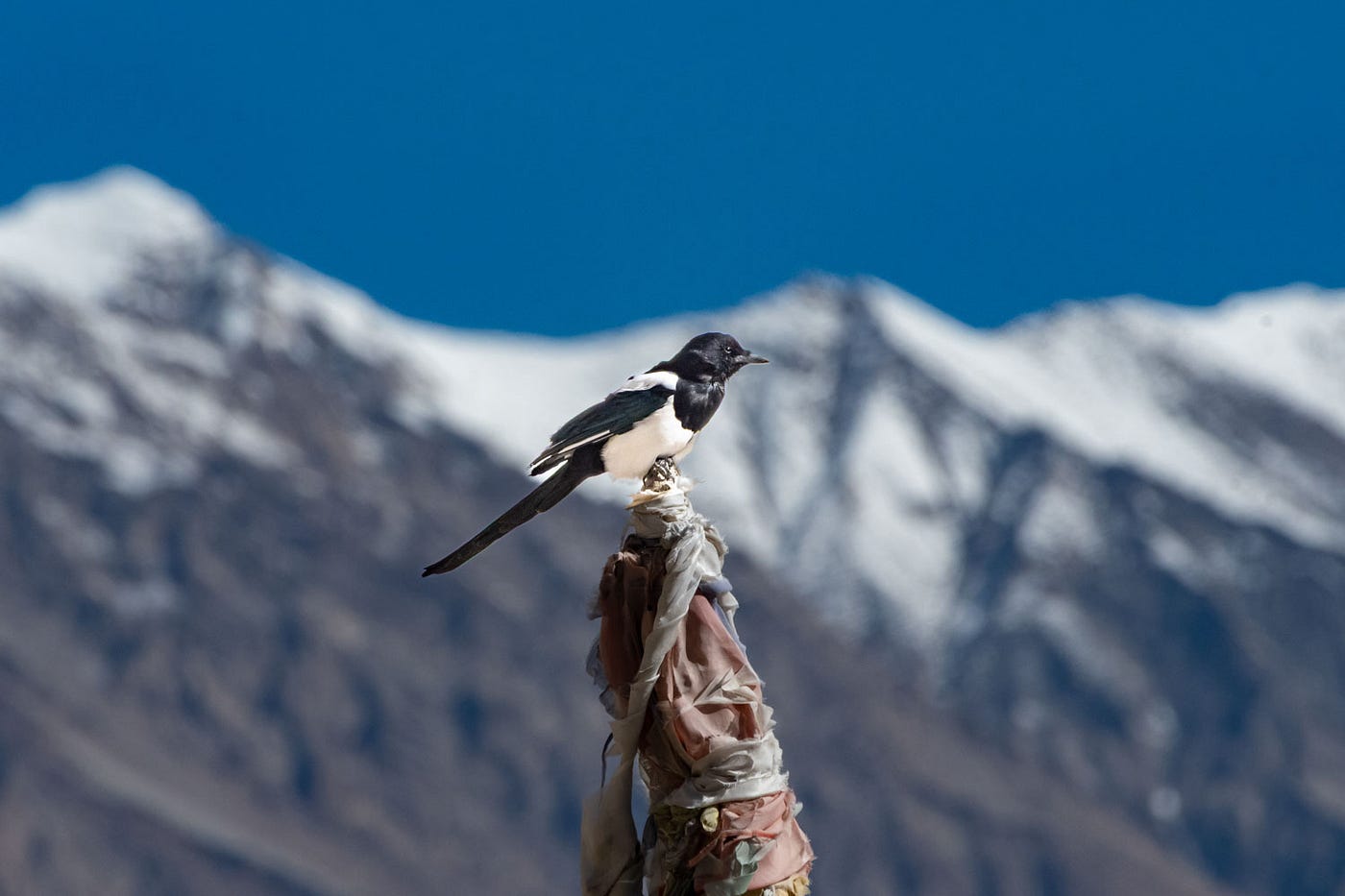
But the most memorable shot came in a snow-covered mountain region at 17,000 feet.
The bird was perched on a tall stump with towering snowy peaks behind it. To capture both the bird and the snow-covered mountains with clarity, I needed the background to be as clear as possible. I narrowed down the aperture to f/8, but it still created too much blur. So I gradually narrowed it down further up to f/14 while checking the preview each time. It took me a few minutes to get the right balance.
During those minutes, the bird quietly stayed there as if posing for me. Maybe she knew I would write about her later.
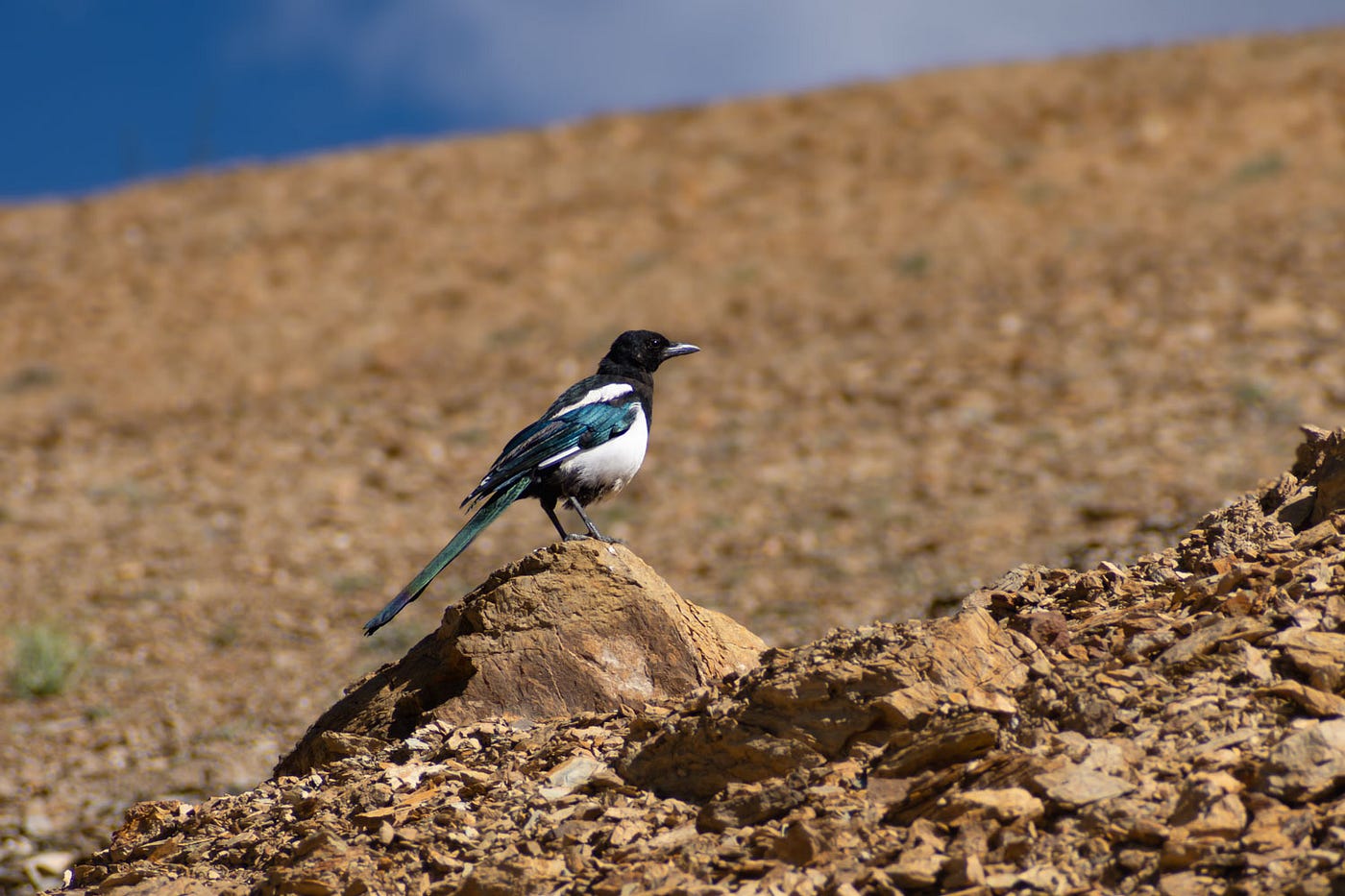
During the final leg of my journey, we crossed a completely barren and cold desert. The land was endless and brown. Wildlife is scarce in these regions. Only the Tibetan Wild Ass, which is known to survive in the harshest deserts, is commonly seen here.
But I expected Mr. Magpie to show up. And there he was, perched atop a mound and looking straight at me.
My guide was surprised as he had never seen anyone take so many pictures of Eurasian Magpies. He even casually asked me if my main purpose for the Ladakh trip was to capture its stunning landscape.
But well, how does an insane birder like me tell him how fascinated I was seeing the same bird complement such diverse landscapes while still maintaining its bold personality?
Every time I saw the shimmer of blue and green, I instinctively reached for my camera. It was also fascinating to see how these birds chisel through the ice with their beaks to find food hidden beneath the snow. Their resilience is admirable.
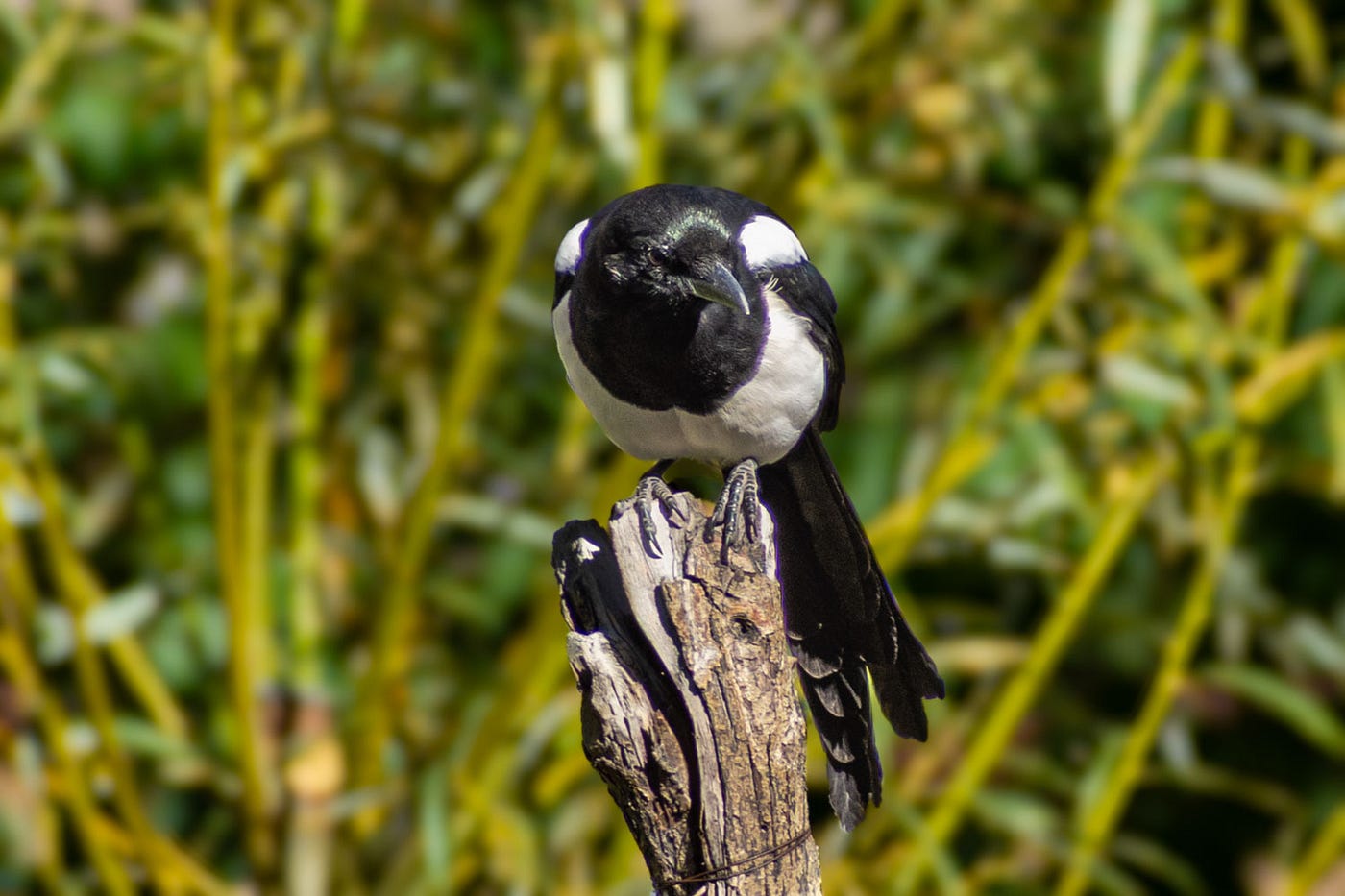
By the end of the trip, I had started calling it the “Ladakhi Magpie” because the name felt truly deserved. It is a bird that represents the spirit of Ladakh with its adaptability, toughness, and confidence. If we take the colonial naming convention away from the birds and name them true to their habitat, the Ladakhi Magpie seems more fitting. What do you say?
In a land where the terrain keeps changing, and silence stretches far into the horizon, this Magpie is a constant reminder that beauty and resilience often come from simplicity.